The core of Neuro-Linguistic Programming (NLP) since its foundation has been the modelling of human excellence. At the heart of modelling lies a deceptively simple yet profoundly generative question originally articulated by Gregory Bateson: What is the difference that makes the difference? This question continues to guide me not only in my own application of NLP but also in a broader exploration into the nature of human genius, creativity and transformation.
From the beginning, NLP set out not merely to describe excellence, but to understand its underlying subjective structure – those deeper patterns of thinking, perceiving and inner representation that enable certain individuals to produce extraordinary results. The aim was never imitation for its own sake. Rather, it was to discover how excellence is produced, so that it might be cultivated, extended and, ultimately, re-created in new and evolving forms.
The deeper structure of excellence
Traditional approaches to learning often emphasize the replication of behaviour – observing what successful individuals do and attempting to reproduce those actions. While this can yield useful results, it rarely captures the essence of true mastery. What NLP modelling revealed early on is that behaviour is only the surface expression of deeper internal processes.
Exceptional individuals do not simply do different things; they perceive differently, organise experience differently, and relate to systems differently. Their actions emerge from a rich interplay of beliefs, values, sensory awareness, inner representations and systemic understanding.
Thus, the focus of NLP modelling involves the shift from what people do to how they do it:
- How they filter and interpret reality
- How they organise their internal representations
- How they make decisions and determine appropriate actions
- How they interact with the larger systems of which they are a part
It is at this level – the level of generative patterns – that true excellence resides.
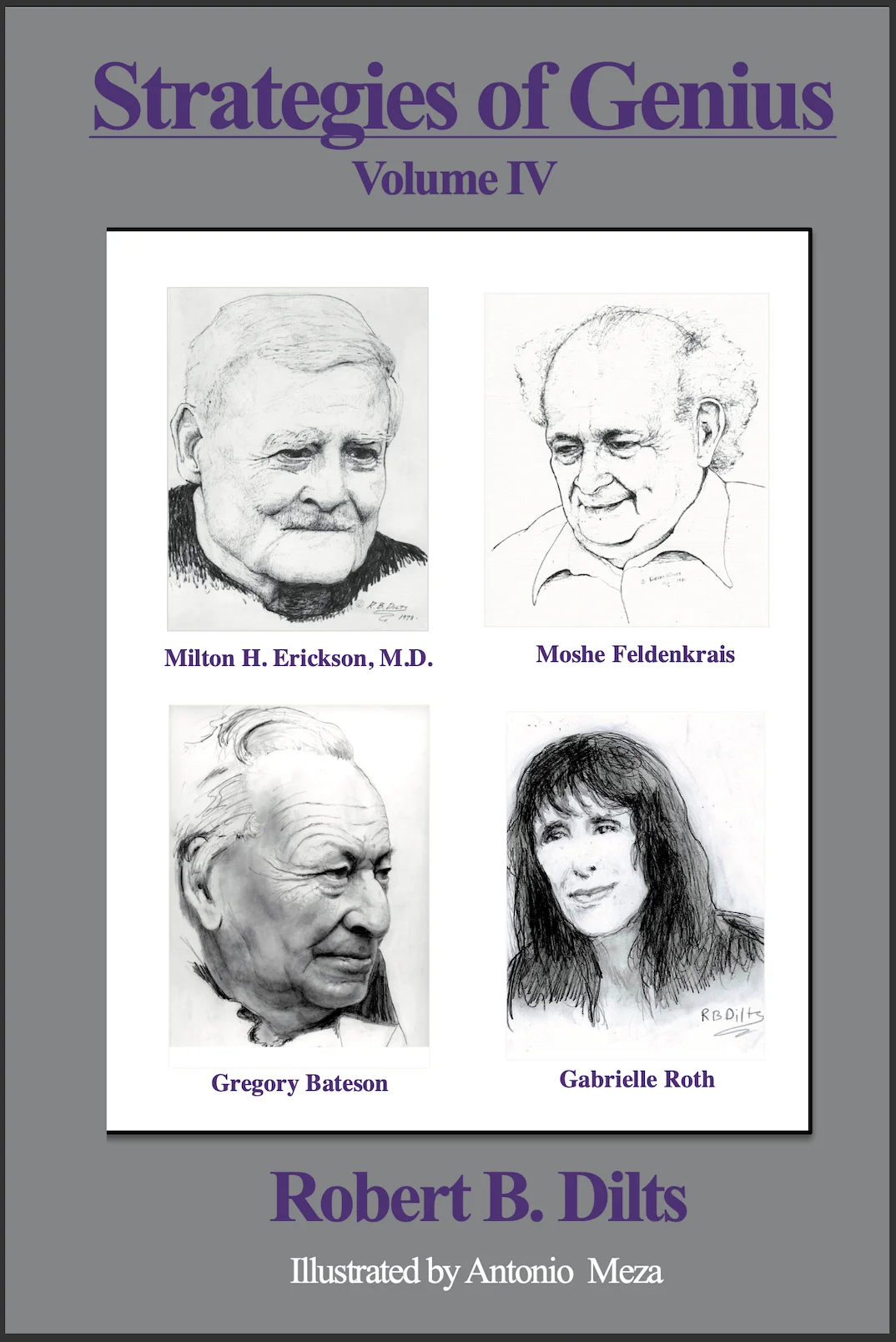
Encounters with genius in the area of human development
On my own journey, I have had the extraordinary privilege of personally encountering individuals whose genius has shaped entire fields of human understanding and development. Among them are Milton Erickson, Gregory Bateson, Moshe Feldenkrais and Gabrielle Roth, who are the subjects of my forthcoming book Strategies of Genius Volume 4. Each of these individuals expressed their genius through a unique modality:
- Erickson through language, metaphor and unconscious communication
- Bateson through systems thinking and ecological awareness
- Feldenkrais through movement, somatic learning and embodied awareness
- Roth through rhythm, trance and expressive movement
At first glance, their approaches appear significantly different. One works with words, another with ideas, another with the body, and the other with movement and rhythm. Yet, as I became more familiar with each of their methods, a key realization emerged: their effectiveness did not come from rigid techniques or fixed methods. In fact, what made them extraordinary was precisely their freedom from technique.
The common ground of genius
Despite their differences in modality, these individuals shared a set of underlying principles – what might be called the generative structure of genius. These principles are not techniques in themselves, but orientations toward experience that enable the emergence of new possibilities.
1Respect for Unconscious and Embodied Intelligence
Each of these geniuses recognised that intelligence is not confined to conscious thought – that there is a more inclusive intelligence beyond the cognitive mind. The body, the unconscious mind and the broader ecosystem all possess forms of wisdom that can guide change in a naturally ecological manner. Milton Erickson, for example, trusted the unconscious mind to generate solutions uniquely suited to each individual. Moshe Feldenkrais worked with subtle movements to awaken the body’s innate capacity for learning and adaptation. Gabrielle Roth accessed transformation through rhythm and embodied expression. In each case, change was not imposed from the outside but evoked from within.
2Trust in Self-Organising Processes
A second shared principle is a deep trust in the self-organising nature of living systems. Rather than attempting to control outcomes directly, these individuals created conditions in which change could naturally emerge. Gregory Bateson emphasized the importance of understanding the patterns that connect systems. He recognised that systems – whether individuals, families or ecosystems – tend toward naturally self-organising principles when properly supported. This perspective shifts the role of the practitioner from ‘fixer’ to ‘facilitator’. The goal is not to force change, but to create the context in which change becomes possible – even inevitable.
3Sensitivity to Context and Relationship
Another hallmark of genius with respect to human development is an acute sensitivity to context. What works in one situation may not work in another. Rather than applying standardized techniques, these individuals responded dynamically to the uniqueness of each moment. Erickson, for example, would tailor his communication to the specific language patterns, beliefs and experiences of each client. Feldenkrais adapted movements based on subtle feedback from the body. Roth allowed the rhythm of the moment to guide the process. In all cases, effectiveness arose from a deep attunement to relationship – between self and other, between parts of a system, and between the individual and their environment.
4Orientation Toward Wholeness
Perhaps the most profound commonality between these geniuses is an orientation toward wholeness rather than fragmentation. Rather than isolating problems or breaking experience into disconnected parts, each of them worked to create greater integration. They recognised that symptoms often arise from disconnection – between mind and body, between individual and environment, between intention and action. Their work aimed to restore coherence, alignment and flow. This orientation transforms the very nature of change. Instead of ‘fixing what is broken’, the focus becomes ‘reconnecting what has been separated’.
Modelling generativity
The essence of ‘genius’ is generativity – the capacity to create something new. Like everything we humans do, this is a process that has a structure. One of the paradoxes of creativity and genius is that they require structure and discipline at a certain level. As Gabrielle Roth used to ask her students, “Do you have the discipline to be a free spirit?”
Roth would also counsel those students who said they wanted to be like her: “If you want to be like me then be more like you.” As I wrote in Strategies of Genius Volume 3, modelling genius is not about “following in the footsteps” of the individuals we are studying but rather about “seeking what they sought”. This distinction marks the movement from replication to generativity. To follow in someone’s footsteps is to walk the same path they walked. To seek what they sought is to pursue the same orientation toward discovery, even if it leads to entirely new destinations.
Generative intelligence: the capacity to create
Generative intelligence (or GQ) can be understood as the capacity to produce new patterns, new meanings and new possibilities. It is not bound by past solutions but is continually evolving in response to new contexts. With respect to human development, this form of intelligence involves several key capabilities:
- Perceptual flexibility: The ability to see situations from multiple perspectives
- Systemic awareness: Understanding how elements interact within a larger whole
- Creative responsiveness: The capacity to adapt and innovate in real time
- Alignment with deeper purpose: Acting in accordance with values and intentions that transcend immediate outcomes
Generative intelligence is not something one ‘has’ but something one cultivates. It emerges through practice, reflection and engagement with complexity.
The role of the modeller
In this context, the role of the modeller becomes that of an explorer and translator of human potential. Rather than extracting formulas, the modeller seeks to uncover the principles that give rise to excellence. This involves:
- Observing patterns across different individuals and contexts
- Identifying the beliefs, values and assumptions that guide behaviour
- Mapping the relationships between internal processes and external results
- Translating these insights into forms that can be learned and applied
Importantly, the goal is not to create clones of existing geniuses, but to enable others to access their own unique expressions of excellence.
Becoming a source of excellence
Ultimately, the focus of modelling genius is not on the past, but on the future. It is not about preserving what has already been done, but about expanding what is possible. To model genius is to ask:
- What principles allow creativity and excellence to emerge?
- How can these principles be cultivated within ourselves and others?
- How can we apply them in new domains and contexts?
In this sense, modelling itself becomes a generative act – a way of participating in the ongoing evolution of human capability.
Conclusion: seeking what they sought
The true legacy of the great innovators and visionaries is not the specific methods they used, but the spirit of inquiry and discovery they embodied.
Milton Erickson did not leave behind a fixed set of techniques to be replicated. Gregory Bateson did not offer a single model of systems thinking to be applied universally. Moshe Feldenkrais and Gabrielle Roth did not prescribe particular movements in rigid terms.
What they offered instead was an invitation – an invitation to explore, to perceive more deeply, to trust the intelligence of life, and to participate in the unfolding of new possibilities. In this light, modelling genius becomes a pathway not to imitation, but to transformation.
It is a journey from asking, “How can I do what they did?” to asking, “How can I become a source of what is yet to be created?” And in that shift, we move from reproducing excellence to generating it.